A Sign In Space


Imagine one day radio telescopes around the world receiving a mysterious message from Mars. What does it contain? How to make sense of a message coming from outer space? These questions and the general premise describe A Sign In Space in a nutshell.


Daniela de Paulis conceived this project over the span of several years. The team she formed comprises over 70 individuals, including scientists, intellectuals, and artists, other than key collaborations with the SETI Institute, the European Space Agency, the Green Bank Observatory and INAF, the Italian National Institute for Astrophysics. I had the privilege of joining the project only in November ’22. However, I could make a meaningful contribution as I was part of the message team, along with Daniela and astronomer Roy Smits.


In a live performance on May 24th, 2023 the message that was loaded on the Trace Gas Orbiter, a spacecraft orbiting Mars, was beamed back to Earth. Since then, a community of space enthusiasts on Discord have been trying to make sense of the message. As of early 2024, the message is considered by the community to contain a header, body, and footer. The body, predominantly rendered as a 256×256 image, has become popularized as “the starmap”.


I won’t reveal much else until the community finishes interpreting the message. However, I can share that working on this project was an immensely humbling experience for me. The challenge of putting oneself in the shoes of another sentient entity in the universe is mind-bending to say the least. Having worked together with so many talented people made up for some of that sense of insurmountability of the task. A Sign In Space was for me also a wonderful excuse to review some of the scientific work done before us, like the Arecibo message, the Voyager Golden Record (and more generally the work of Carl Sagan), and discovering much more, like the great project by Jordi Portell.


Visit the website of the project or the discord channel for more information on the status.
The Infinite Conversation

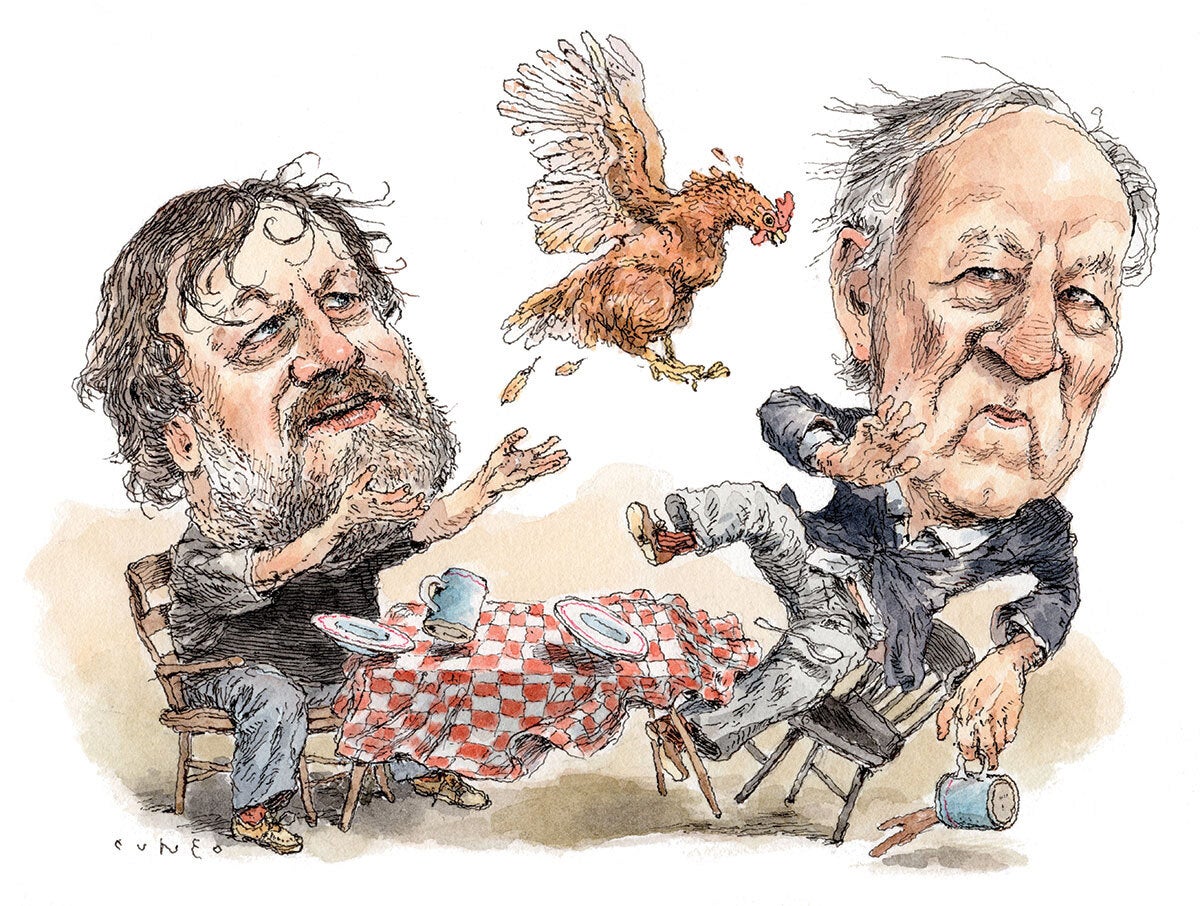
(Illustration courtesy of John Cuneo)
 

The Infinite Conversation is an AI-generated, neverending conversation between Werner Herzog and Slavoj Žižek. Upon entering the website, the visitor is taken to a random point in the dialogue. New segments of the conversation are automatically added at various times and they can be generated at a faster speed than what it takes to listen to them. In theory, the conversation can continue until the end of time.


Built with freely available tools, this work was born out of a simple epiphany: that in 2022, voice cloning tools were becoming both too good and too easy to use. And that the world was (and will remain for a long time) utterly unprepared to deal with the potentially heinous consequences.


I am not proud of having created this without asking consent from Werner Herzog and Slavoj Žižek, but I think that was an important part of proving the point: unscrupulous players might have even fewer moral qualms while unleashing these powers upon far more nefarious uses. I wish Žižek took the jest in higher spirits than he did. But I have reasons to believe that at least Herzog approached it more philosophically. Then again, I also learned that Herzog does not hold Žižek very dear, so I’m sorry to have accidentally created a version of hell for his AI-avatar.


As of June 2023, over a million minutes of the Infinite Conversation have been listened to by many hundreds of thousands of people around the world, hopefully contributing to spark a conversation that at the very least, will raise awareness about Deepfakes. Read more about this project on Scientific American, Tank Magazine and Literary Hub.

Pen-plotter works


[open full screen gallery]


About a month before the 2020 lockdowns I received an Axidraw pen-plotter, a wonderful machine I had been eager to experiment with for some time. I am quite terrible at hand-drawing, but I had a number of ideas that seemed better suited for paper rather than a screen. I also had countless other concepts eager to be revamped into illustrations. Overall, the pandemic’s timing worked in my favor – the creative outlet it provided was so liberating that I almost regretted returning to social obligations. I exaggerate, but for one brief moment in my life most of my energies could be dedicated to rapidly learning a new medium – and it was great.


Like with many interesting modes of expression (cough- haikus -cough), the allure of pen-plotting derives from the constraints imposed by the medium. There’s no obvious control over stroke hardness, using multiple colors is a pain, shading is not subtle. Short of bending the medium itself, the artist is essentially limited to lines and dots.


And yet, entire worlds quickly materialize from the robotic hand’s precise movements. Watching the plotter doing its work has an oddly soothing quality. Once the plotting job starts, there’s no intervention – all you can do is watch if you did your homework right, if the code you wrote translates well to the picture you envisioned, if you chose the right pens and paper for the job. The difference between the digital version and the final product is always remarkable.


An additional aspect that was new to my practice was the community centered around pen-plotting, aptly named #plotterTwitter. And even if normally I refuse to join any club that would have me as a member, I felt humbled to be part of this cohort for some time. It served as a safe space for exploration, where everyone was supportive and helpful to one another – a stark contrast from the world the media portrayed during those days. Hannah Twigg-Smith excellently captured the essence of the community in her paper Tools, Tricks, and Hacks: Exploring Novel Digital Fabrication Workflows on #PlotterTwitter.


I wish to never fall out of love with this medium. The passion of my pandemic honeymoon with the pen-plotter is over, but there’s a lot, so much, that I still want to express through those automatic arms.

The Adventures
Di Pinocchio

You shall know a word by the company it keeps
(John Rupert Firth)

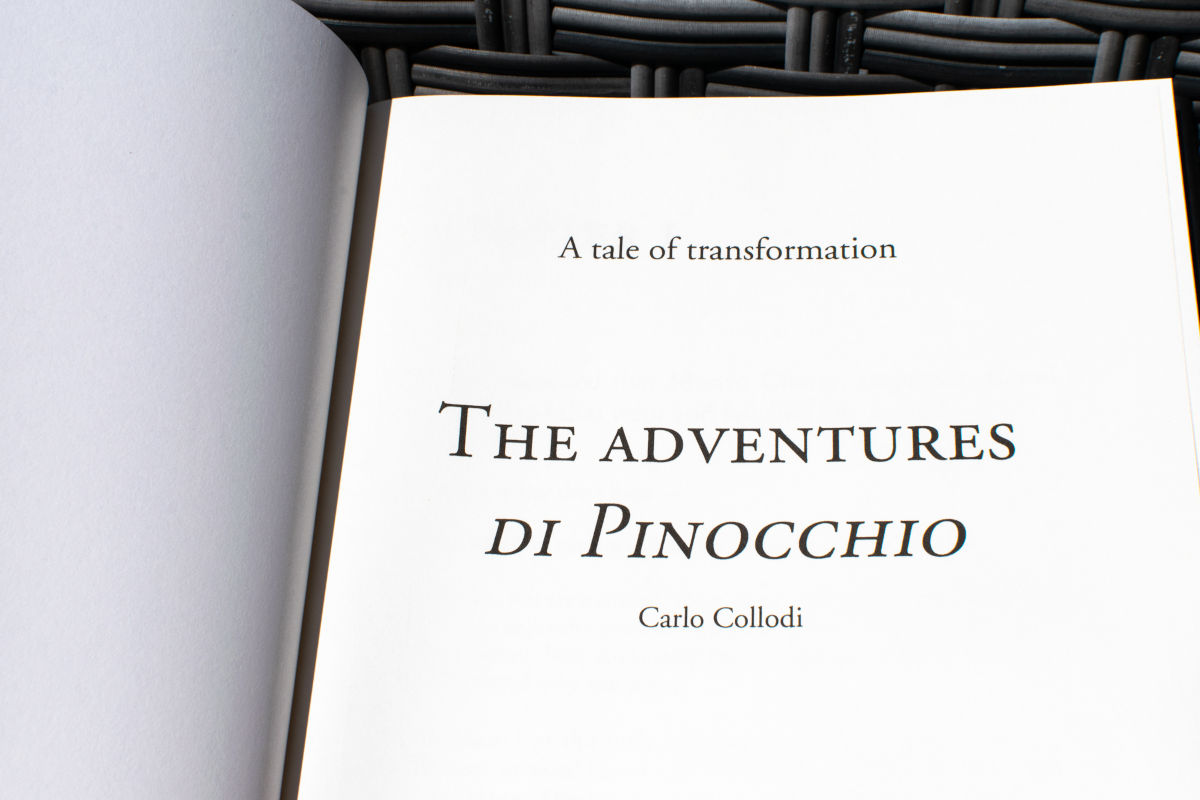
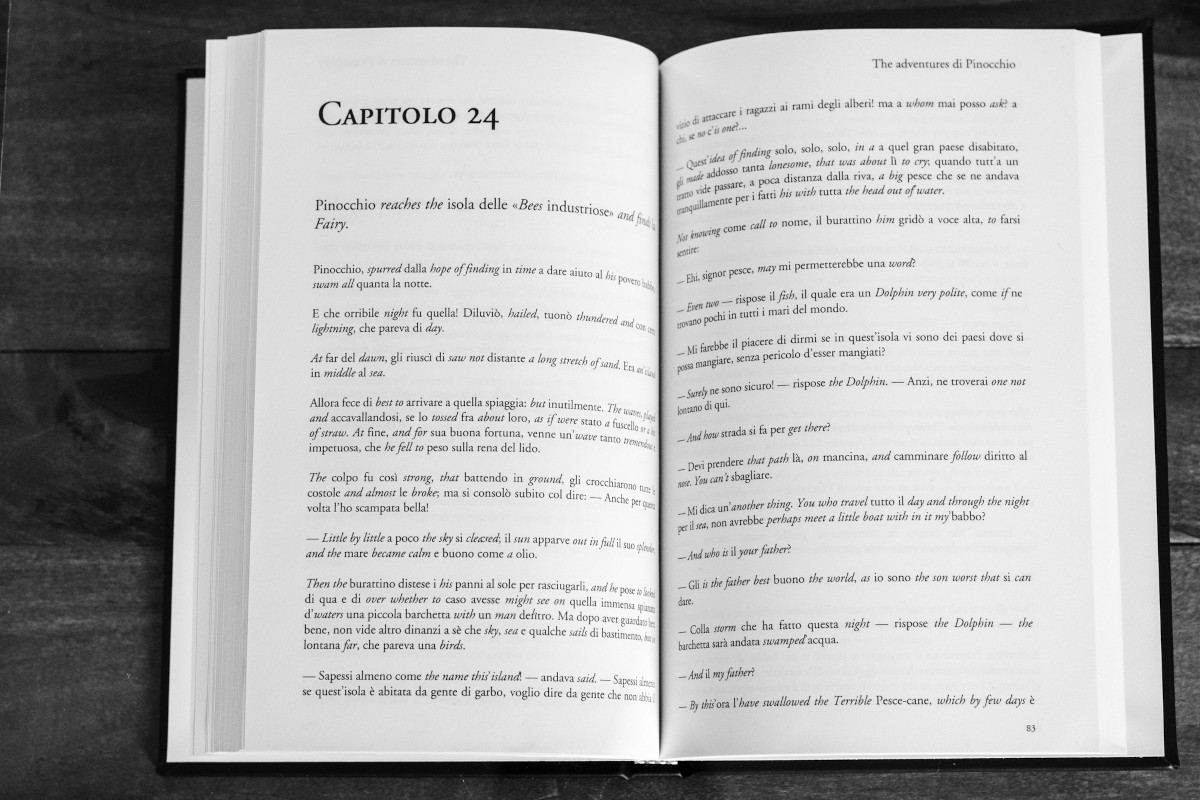
The premise of The Adventures Di Pinocchio is simple: what if we could learn a new language simply by reading a book? What if we could do that without realizing it?


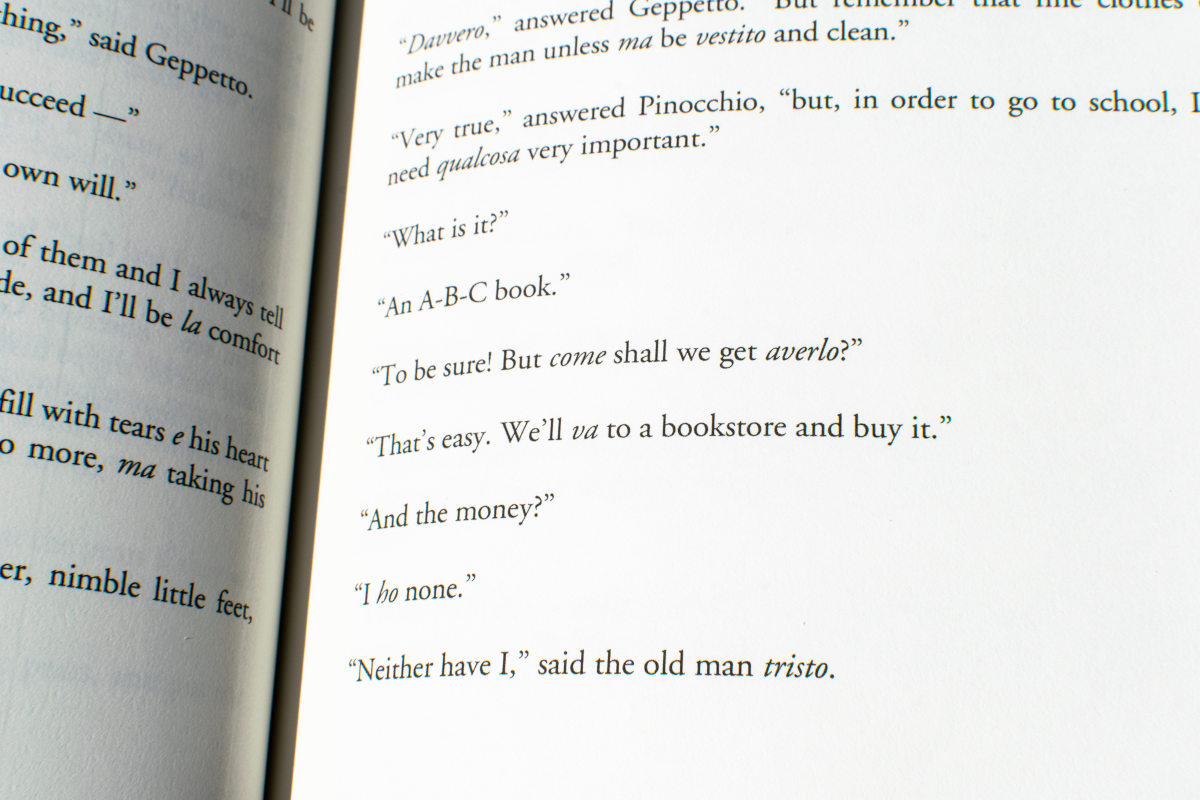
We’re all familiar with the notion of learning a new word after finding it in a well-known context. By seeing an unknown term surrounded by words we already know, we can pinpoint the general meaning of the new one simply by inference. As the new word is seen in more frequent and varied ways, its meaning can be refocused and we become capable of understanding and using it correctly. Now imagine doing that with words in a language you do not know. And if it’s true that to have another language is to possess a second soul, wouldn’t it be great to learn one while enjoying a novel?


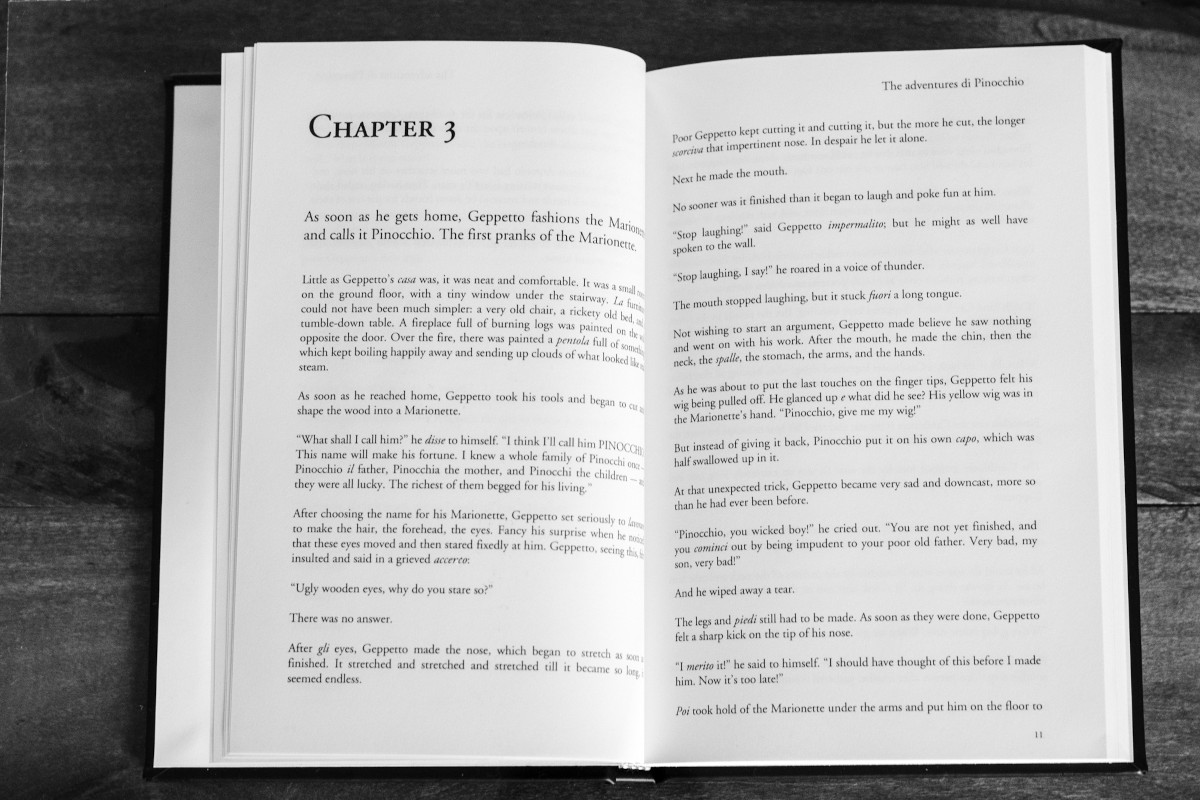
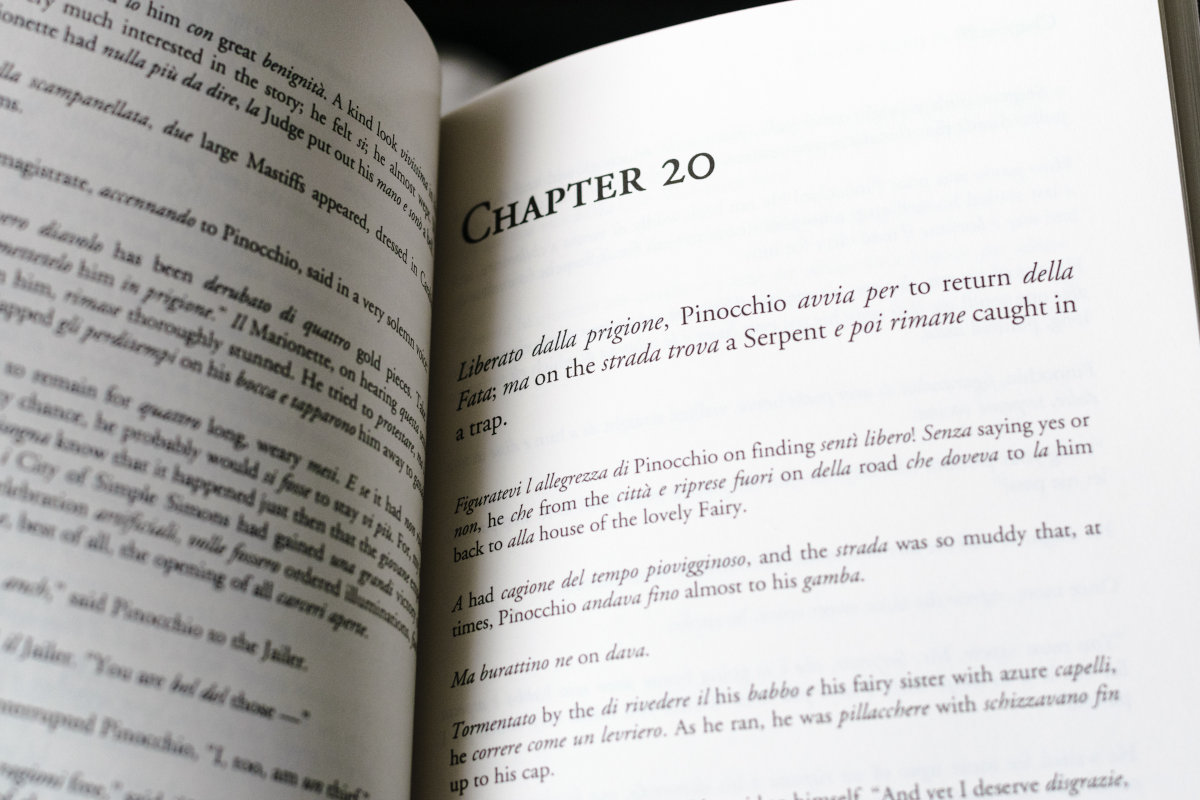
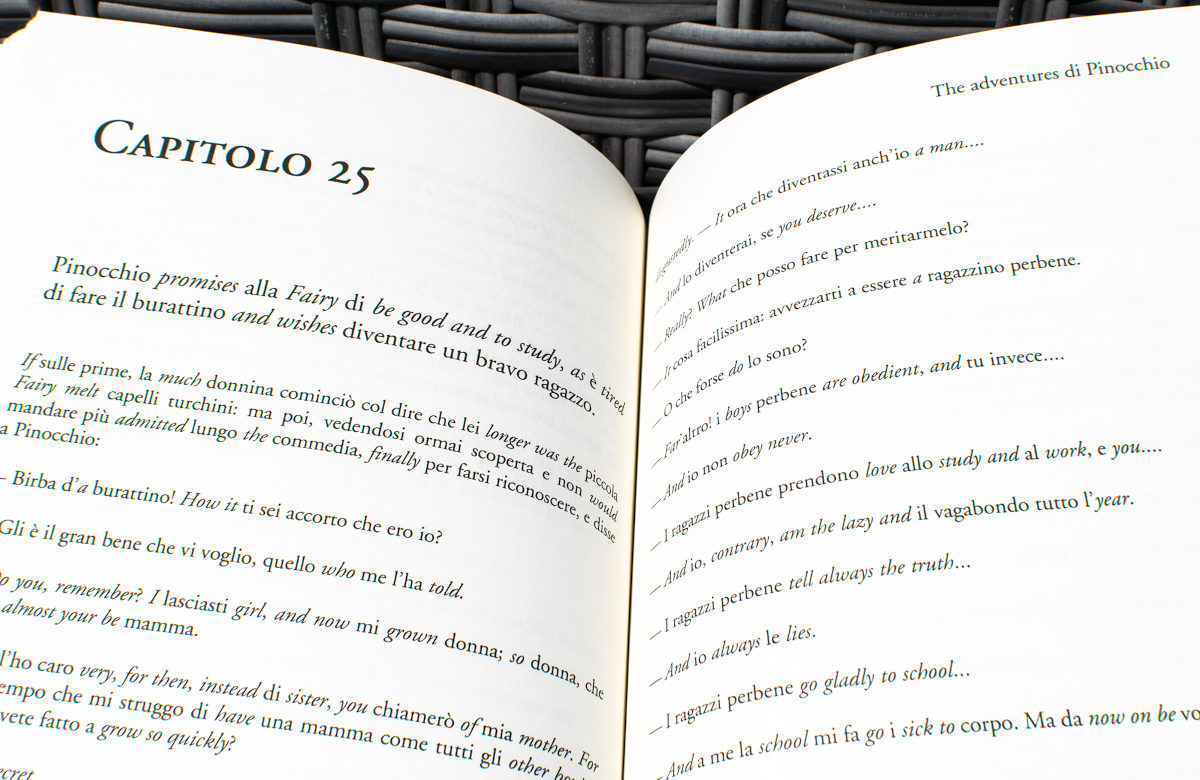
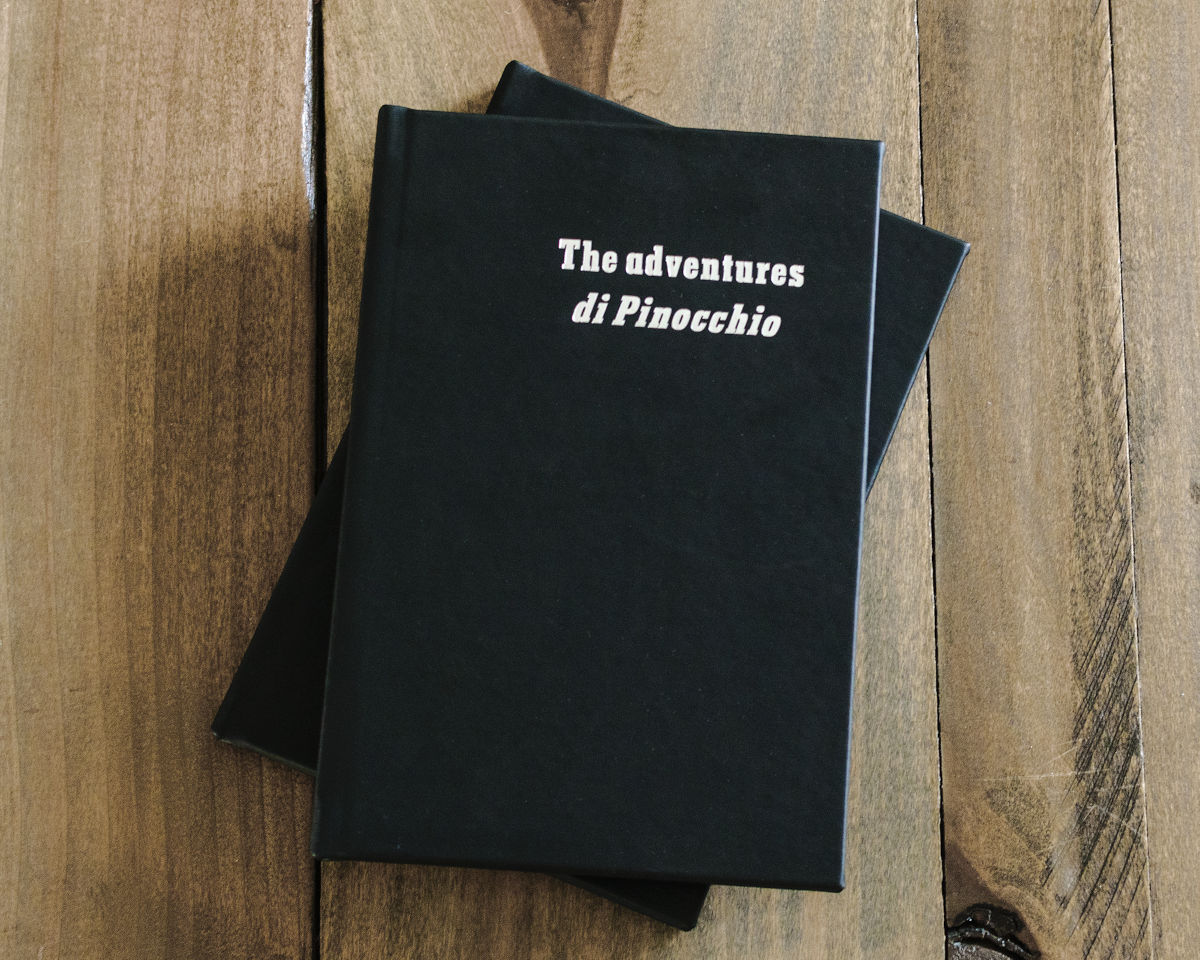
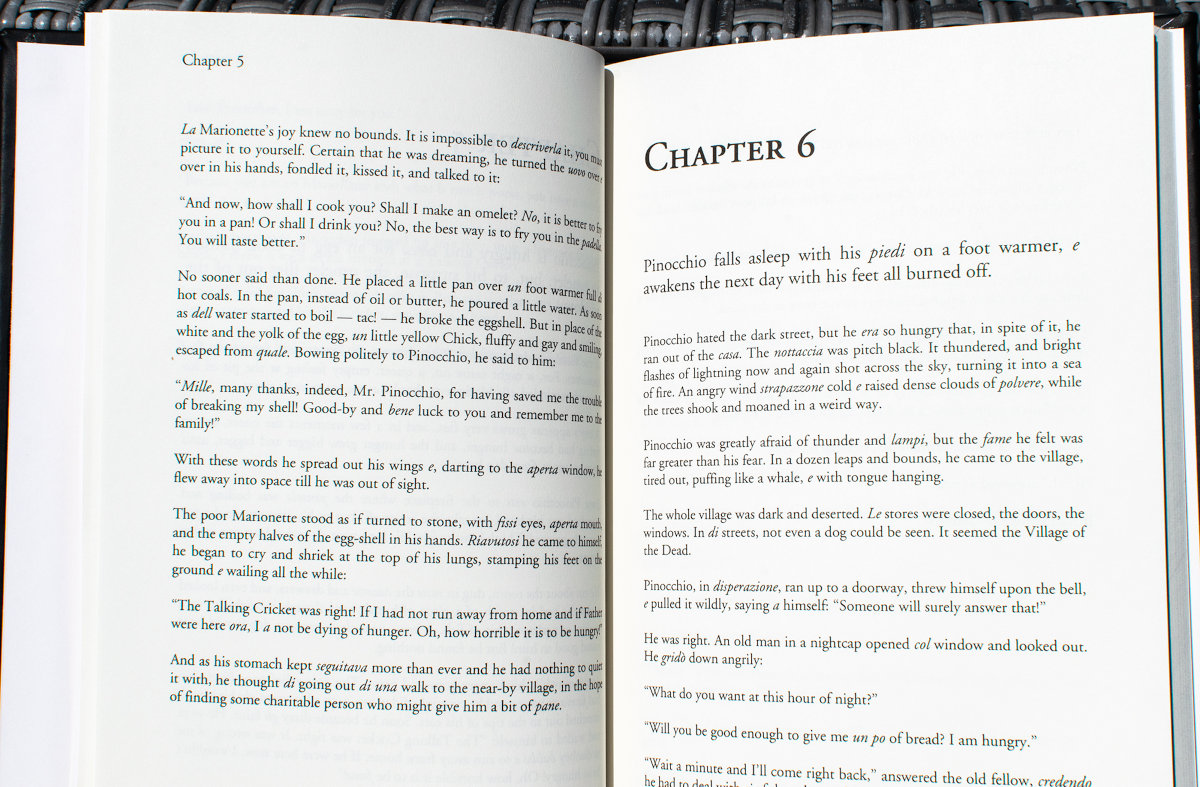
The Adventures Di Pinocchio is two books in one: the English translation of Pinocchio is gradually mixed with the original Italian version. In the first few pages, an Italian word pops up here and there, made obvious by its italic type. Gradually more and more words are added to the mix. By the first quarter of the book, we see the first few, very short Italian sentences. By the middle of the novel, half of the words are in English, half in Italian. Eventually, the book ends in its original form, in glorious 19th century Italian.


Some parallelisms came to my mind while I was putting together this book. First and foremost: the journey. Pinocchio yearns to become a real boy, in the same way as any translation wants to be as close as possible to the original. Only by the end of the book you get to enjoy the prize of the real thing.


Second: the original Pinocchio is darker than any adaptation you might have seen as a cartoon or movie. Its roughness resonated with me as I witnessed the results of a “machine-mediated” linguistical metamorphosis: if translating is an arduous effort, gradually morphing sentences is bound to create even more friction. But when it does work, it is so much fun to read the ambiguous, demilitarized zone that is the bilingual sentence—the pleasure and pain of every parent of every bilingual child.


And lastly: the big lie. As Pinocchio struggles to keep his stories straight, so does The Adventures Di Pinocchio. Can you really learn Italian by reading this? Of course not. 160 pages are not nearly enough. But it’s a great start. For a more complete language transformation, I will focus on applying this same method to “In Search of Lost Time” (À la recherche du temps perdu, by Marcel Proust), a novel tallying a whopping 2,215 pages. Now that’ll be your chance to learn French!

polygonSelfie

[open SVG gallery]

Update January 2023


Google Play decided that my app is too old and unmaintained to allow people to run it on their modern devices. However, after testing on Android 13, it looks like the app still works for the most part. Download the latest APK from here.


——————————————————————————


What makes a face unique? Faces are packed with details and information about a person’s past (age, sex, race, identity) and future (attention and focus). How much detail can we remove from a face before it stops making sense to us? One possible approach would be to reason in pixels and find the minimum resolution required to make a face identifiable. For instance, the following image has only 24×24 discrete points.

Monna chi?


Another approach is to reason like a facial recognition system. In the world of biometrics, there are several ways to identify each face, and they are often combined to achieve better results. One of these approaches consists of tracking distinct features of a face, (chin, mouth, left and right eye…) in a 2 or 3D space. Measuring the distance between those points can yield good results in identifying a face.


This is where polygonSelfie enters the picture. Looking at the wireframe version of our faces reveals a seductive and deceptively simple aesthetic. Gone are the messy details of the window to our soul. We are left with a barebone, vectorial version of ourselves. As selfies continue to represent the story of Narcissus in the XXI century, polygonSelfie offers us a peek into an increasingly likely future, one in which the continuous merging with the Machine and the acceptance of a universal Panopticon have become the norm.


polygonSelfie is an Android app, compatible with most mobile phones and tablets with an integrated camera. polygonSelfie is very processor-intensive and its prolonged usage may over-heat your device. polygonSelfie could not exist without the fabulous community behind openFrameworks, the powerful dlib toolkit and, last but not least, Boris Nikolaevich Delaunay.

WikiBinge

wikibinge

WikiBinge (Noun | /ˌwiːkiˈbinj/): Compulsive urge to read connected Wikipedia pages for a long amount of time.


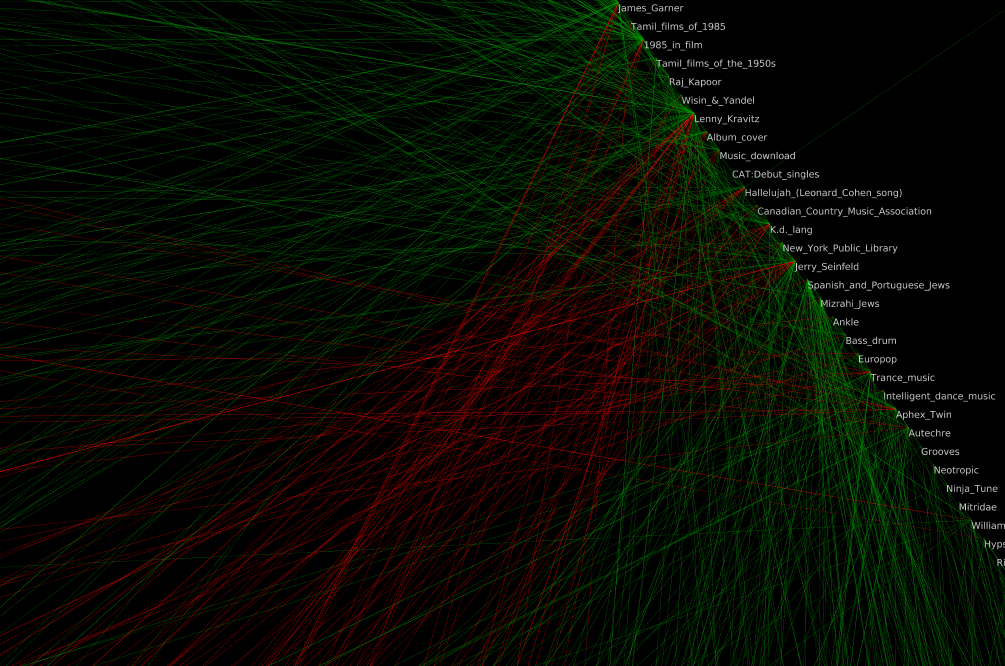
WikiBinge is a tool for creating interesting paths between two subjects chronicled on Wikipedia. WikiBinge generates the story of how flimsily Alpha is connected to Omega and compels you to follow that rich, linear narration through unexpected discoveries and findings.


But what does “interesting paths” mean? Those familiar with the theory of six degree of separation won’t be surprised to discover that it’s possible to connect most Wikipedia articles following just a few links. However almost every shortest path is ridden with banality, passing through huge hyperconnected articles like “United States of America” or “World War II”.


WikiBinge instead tends to generate paths that require dozens of links to reach the destination. What matters is the journey, not the destination. Embracing this spirit, WikiBinge selects the smaller, less represented articles on Wikipedia during this journey. In a WikiBinge path the underdogs are the kings.


What WikiBinge shows during this journey mirrors the distribution of content on Wikipedia. It’s quite common for a WikiBinge path to go through unknown actors, sportsmen or remote places. This is consistent with the findings of previous studies on the distribution of topics in Wikipedia, like [Kittur, A., Suh, B., Chi, E. (2009). What’s in Wikipedia?], which places at 59% the amount of content about “Culture and the arts”, “People and self”, “Geography and places” on Wikipedia.


Also, editors of the English version of Wikipedia (which recently passed the 5 million article mark) tend to have an English Bias, a Western Bias, and they tend to be highly educated and computer savvy. This is all reflected in the results of WikiBinge, as you will promptly find by navigating through a streak of 15 articles about lesser known comic characters.


That everything is connected with everything is now common sense. But it’s how things are connected that keeps surprising me over and over, even as a longstanding fan of James Burke’s Connections.


WikiBinge is the product of a society with a problem of information overload. It reminds us how compulsive consumption of information is deeply ingrained in our way of thinking and how fiddling with snippets of information for its own sake is like trying to quench an infinite thirst.


This is perhaps why WikiBinge is, like “The Road Not Taken”, a wolf in sheep’s clothing. It fools us into thinking about the beautiful results of choosing the path less traveled, but its self-deception is revealed too late, when we’re sinking in an ocean of information. And sinking in this sea is sweet to me…

Cutup


Cutup rearranges the words of the messages you receive and generates small composition of depthless wisdom and questionable hilarity. If you exchange a lot of SMSes with your buddies, this app is for you. The generated snippets of poetry try to follow as closely as possibly the haiku rules and will match the writing style and themes of your friends.


The app attempts to imitate two of the three haiku qualities: the “cutting” (kiru) and the 5-7-5 rule. The rule of kigo (seasonal reference) was implemented and later discarded in favor of a more desirable property, language independence. If your peers write to you SMSes in any latin-scripted language, you will probably be able to run Cutup. Very interesting haikus were generated in the following languages: english; portuguese; italian; spanish, french. I suspect that it wouldn’t work so well with German due to the larger average letter-count of the deutsche Sprache, but feel free to try it out for yourself.


In order to get the best results, use Cutup with the person you exchange the highest amount of interesting message. For this funny app I express my love and gratitude to: Paulo Patricio, Mark V. Shaney and Apophenia.

——————————————————————————

Update June 2016


Cutupbot is a modernized and revamped version of Cutup written for Twitter. It’s a simple bot that creates haiku using the style of any given profile on Twitter. To interact with Cutupbot, simply send a message on Twitter @cutupbot indicating which account you wish to plagiarize. For instance “@cutupbot could you write for me a haiku of @dalailama?”, or simply “@cutupbot @dalailama” if you feel imperative.


Usually results will be more interesting or convincing if the account selected has at least several hundred messages. If Cutup doesn’t find a certain amount of words, it will refuse to generate a haiku.


Options:
You can specify to generate five messages at the time adding on your message the hashtag #gimmefive. If the account you are plagiarizing uses the English language, you may try the optional hashtag #kigo. Looking for a kigo works well only on a few accounts and your mileage may vary. Options can be combined together. “@cutupbot @dalailama #gimmefive #kigo”


Update January 2023


Google Play decided that my app is too old and unmaintained to allow people to run it on their modern devices. However, after testing on Android 13, it looks like the app still works for the most part. The irony is that one of the few places in the world where people use SMSes and where this app could be relevant, is also the country where the presence of an Android phone is still looked as some sort of contagious disease: the US of A.


At any rate, if you wish to install the app on your device, you can download the APK from here.


It also looks like Mr. Musk decided to make Twitter a less stable platform for bots and I decided to pull off the bot, rather than maintaining it. If you wish to see how it looked like in a very ancient past, the Wayback Machine is there for us.


Lastly: the offspring of Cutup is a LLM paper.


Burning Rome


Burning Rome è una mappa della distribuzione del reddito della capitale Italiana. Di solito questo tipo di mappe mostrano solamente i valori medi di un area. Anche Burning Rome permette di vedere le medie, ma ciò che la rende veramente unica è la possibilità di zoomare al livello della singola casa e visualizzare il reddito dichiarato dal singolo individuo.


Roma è la città in cui sono cresciuto. Sin dall’adolescenza sono stato esposto alle divisioni socio-economiche della città, alla triste ghettizzazione di certe aree e alle zone chic di estremo benessere. Questo progetto cerca di visualizzare ciò che in larga misura è già noto, ma nel farlo getta luce su un altro problema importante.


La cosa più rivelatrice di questa mappa non è lo scoprire dove siano le persone molto ricche, quanto dove siano quelle molto povere. Dal momento che i dati visualizzati si basano sulle dichiarazioni dei redditi e dal momento che tale dichiarazione è falsificata da molti in modo da nascondere il benessere all’Agenzia delle Entrate, è ragionevole aspettarsi che coloro che appaiono come ricchi non dichiarino più di quello che guadagnano, mentre molti dichiareranno meno di quello che è il loro vero reddito. Ci saranno probabilmente dozzine di modi per spiegare la quantità di gente che -secondo i dati- vivono ai margini della povertà nelle aree più costose ed esclusive della città. Tuttavia un dubbio ragionevole sorge.


I dati usati per questo progetto non sono aggiornati e provengono dalla controversa iniziativa di liberazione delle informazioni presa dalla Agenzia delle Entrate nel 2008, quando tutte le dichiarazioni dei redditi degli Italiani relative all’anno 2005 furono pubblicate online. Sebbene la dichiarazione dei redditi sia un atto pubblico e come tale liberamente consultabile, la popolazione italiana (rappresentata dal Garante della privacy) ha chiesto a gran voce che le informazioni fossero ritirate in nome della protezione dei dati personali, andando contro ogni professata e desiderabile trasparenza.


Circa un milione di dichiarazioni dei redditi erano reperibili nel dataset originariamente pubblicato. Fra queste 103.615 sono state campionate, geotaggate e mappate su Burning Rome con un colore a seconda del reddito. Tutte le informazioni personali sull’individuo sono state scartate durante il processo.


La scelta stilistica di usare una heat-map ha determinato il nome del progetto. Laddove la parte centrale della città con la sua concentrazione di ricchezza sembra una fiamma accesa, le parti più periferiche e tendenzialmente più povere hanno un colore più scuro che sfuma gradualmente con il nero-carbone del fondale. Una metafora calzante del fatto che le fasce di popolazione con meno risorse (e forse con loro molti evasori) sono invisibili agli occhi dei più.


Sono dell’opinione che in una società che abbraccia la libera pubblicazione di dati fiscali i benefici ricavati sorpassano in importanza i timori e le insicurezze di alcuni contribuenti. Il mio sogno è di poter disporre liberamente dei dati fiscali di Roma (come di ogni città Italiana) e poter visualizzare il processo di gentrificazione. Un uomo è libero di sognare.